Prior to adopting our first daughter we had always talked in terms of applying for a second adoption. On the day we sent our first file to China I made our case worker and my husband laugh when I asked ‘when can we apply for no.2’. I think in the back of my mind was an intention that we would apply as soon as it was allowed (which under local law is the one year anniversary of returning home).
However, when the one year anniversary came, both of us knew that for our family it was way too soon. We still felt that we were finding our feet as parents. We were totally in love and in awe of this little person – how could we love someone else as much as we loved her.
Also we were just entering a new phase – at the one year anniversary I had to return to work (local regulations require 1 year off work post adoption – although this can be shared by the parents, although somewhat discouraged) and I was finding my feet as a working mum.
Personally, I felt ‘overwhelmed’ on a number of levels.
There was a period where both of us considered that one child was enough. I think I came back around to the idea of a sibling first – some people might think this is unusual because I am the only child and my husband had a sibling.
As an only child with ageing parents I began to think about how our daughter would feel about the lack of ‘close family’ (ie a sibling) when we were elderly or no longer around. Personally I am fortunate because I have a close relationship with cousins who are a similar age to me (‘sisters’ without the sibling rivalry); our daughter’s cousins are much older than her and don’t have much in common – so I knew she was not necessarily going to have that relationship to fall back on. Our daughter does have a close relationship with her orphanage ‘sisters’ but I was unclear whether that would be long term a ‘substitute’ for a sibling.
The issue of having someone in the family with a ‘shared experience’ also was at the back of my mind.
We headed back to China on a return visit two years after our daughter’s adoption (part of our plan to try and visit China every two years) still with the belief that she would be an only child.
We spent three days in her ‘home’ town and had unlimited access to the orphanage. She had a great time visiting and playing with the babies, as did we. And while you can’t but feel moved by all these little ones wanting to be picked up and held, our decision to adopt again was not a lightening bolt at this point. But I do think it igniting a slow fuse in all three of us.
We returned to home and our daughter continued to talk constantly about the babies in the orphanage - what they were doing now? had their families come for them yet? Her interest in babies was heightened (actually ignited I guess because I don’t recall it being there before).
I started thinking more strongly about giving our daughter a sibling but didn’t mention anything to my husband. But a couple of weeks after our return, the possibility of a promotion came up for my husband and one of the first things out of his mouth was ‘if I got this promotion we could afford to adopt again’ (not that I ever thought money was a barrier). The ‘door’ was slightly ajar and I made sure I got my foot firmly planted in it before it shut again.
‘My foot got quite bruised’ there for a while as my husband tried to pull the door shut again. But as he had raised the topic first he knew I knew he had been thinking about it. Numerous discussions about the pros and cons ensued. But once we made our decision it was full speed ahead and my husband got me to phone the Case Worker the next day.
I have to say the decision was not taken lightly and I think that the second time around the decision was more complex than the first time. The first time we were fulfilling a need in us to provide for a child. The second time we had to factor in the short and long term impact of a decision either way on our first child. And the responsibility of that did weigh on us.
The next big decision was whether to tell our daughter about our plans or not. We decided that it was very important for her to know, not least as a way for her to understand why it had taken us so long to be ‘united’ with her.
We had named our daughter before we were allocated (actually more like 7 years before we were allocated). And she has helped select the name for her future sister – actually she had the casting vote as my husband and I preferred different names – she went with my choice (good girl).
She participated very loudly in our homestudy interviews (as she was 3 ½ yo at the time she did not have to be formally interviewed). In simple terms, she knew we had to write to the officials in China and ask to adopt her sister and the social worker was helping us to write this ‘letter’.
When she started pre-school at the beginning of the year, her classmates’ families were experiencing a mini-baby boom. At this point she so wanted to have a sibling and it helped her to know one would be on the way eventually (she knows it will be long time) and she happily tells her friends she is getting a sister or sometimes it is she ‘has a sister and she is in China’ (on occasions this has not been communicated correctly by her friends back to their parents because I have been asked ‘where is your other child?’).
Although she knows it will be a long time, she doesn’t quite have the concept of exactly how long ‘long’ might be (in fact we don’t either). As the wait continues to extend I occasionally have my doubts about did we tell her too soon, but then we have an animated and joyful conversation (at her request) about what it will be like when her sister comes home and everything feels right again.
I have had a few people outside adoption circles question why we told her, when the wait is so long - most notably my doctor who said ‘how are you going to deal with it if the adoption doesn’t happen?’ – I said no differently than the families of any of your patients that experiences the loss of a baby through miscarriage or still birth – we would all grieve for the loss. This was not something that I had actively considered before, but there are always risks in life, and intercountry adoption, you either embrace them or you hide from them.
Wednesday, 27 December 2006

Thursday, 21 December 2006
Six months down...
Well today marks our 6 month anniversary since log in. The $64million question is are we 1/3, 1/4, 1/5 through? Only time will tell.
Looking back this last month has seemed to take an age to get through but in other aspects it hasn't - it is not like I have had heaps of downtime to mull over the wait, I've been really busy. Maybe it is the looming holiday season.
Looking back this last month has seemed to take an age to get through but in other aspects it hasn't - it is not like I have had heaps of downtime to mull over the wait, I've been really busy. Maybe it is the looming holiday season.
Thursday, 7 December 2006
The Tough Questions
On a regular basis I am reminded that our adopted children are getting older and with it more observant and more likely to start asking us the ‘difficult questions’– such things as was daughter asking where her friend’s dad was (her friend’s mum is single); or attending a China adoption event and seeing all these little people with big personalities (and attitude to burn) running around – I remember a time when there was one or two babes in arms fresh home from China and a whole heap of clucky ‘expectant parents’.
Am I prepared? I don’t think I am but I am trying my best to rehearse in my head what I might say when the tough questions are asked. I just know that these are likely to be asked when I least expect it – like when I’m driving (and likely to take us into a ditch). And then it is likely to be a question I haven’t ‘rehearsed’.
Having listened to adoption specialists talk and read their articles, I realise that it is important to talk as naturally as possible about adoption issues from the outset with our children - to create and maintain communication channels. To be the one that your children hears things from first – not in the school yard, not from friends, not from strangers.
Issues such as baby trading in China are ones that our children need to hear about from us, first. People have long memories, it may be many years down the track when someone dredges their memory and says to our children ‘they sell babies in China, I read it in the paper’. How devastating it would be for our children and our relationship of trust with them if this is the first they had heard of the issue.
It would be easy to say ‘oh, that is a Hunan or Yunnan issue, my child is from…’. Sadly, our children do not come to us with a history of how they entered into the SWI system, even the information that is provided may be a legal ‘falsehood’ (for instance the finding site location may not have a street number but one is made up because the form requires it). We are presented with a series of unknowns and a series of possible hypotheses, that we may not ever be able to test, prove or disprove. But I feel that it important that we share all the possibilities with them no matter how remote they might be, however painful they may seem to us.
When is a good time, well I’m the first to admit that I don’t have that answer – I intend to incorporate age appropriate additional information into our story as time goes by. I think the age of the ‘serious mother/daughter bolt from the blue talk’ (mention it once and lets move on) is long past.
I’m keeping a ‘file’ of relevant material from this period, as an aide memoire for our discussions but also I can let my daughter read these for herself in years to come and draw her own conclusions.
It is so easy to romanticise the events surrounding how our children came to be with us, the children may do so themselves. There are lies and there are lies of omission – both can damage trust in a relationship if discovered. We owe it to our kids, to ourselves and to our long term relationship with them to be as upfront as possible, to communicate and keep communicating with them. To encourage those difficult questions (even if you are trying not to drive into the ditch) and try and answer them as best we can. And if we can’t, we need to be upfront with the kids that we don’t always have all the answers, that sometimes there are just more questions.
Baby Trade timeline
late November 2005 - the Shanghai Daily reports allegations of baby trading allegedly involving orphanages in Hunan’s Qidong County, People’s Republic of China. The paper reported that an alleged baby trader was arrested and made a series of allegations to police that he sold babies to orphanages and social welfare institutions. The paper reported that subsequently police detained 27 managers and workers at the Hengyang County orphanage including Jiang Zhenghua, the orphanage's director; Wang Weihong, the Party secretary of the orphanage, and He Yuhua, an accountant.
Late November/Early December 2005 – issue is carried widely in a variety of overseas media.
14 February 2006 – Jackie Kelly MP is widely reported as saying adopting children from China risked encouraging an international "trade in babies". "I think you do have issues there with the West continuing to plunder the Third World for kids now," Ms Kelly said. "It leads to trade in people. You create a trade in babies. You just don't want to put mothers in that situation where you've got an option of selling a child on the sly to support your other children."
The Australian China adoption community roundly condemns these comments. A range of Australian media have coverage of these comments..
Late February 2006 – trial of the alleged baby traders in Hunan takes place. Chen Ming, the head of Hengdong Social Welfare home, was sentenced on Friday but he is apparently 'on the run'. The heads of Hengyang and Hengdong county civil affairs bureaus, were removed from their posts for their negligence of duties. The officials in charge of the social welfare homes were also sacked. Sentences ranged from 3 to 13 years.
Early March 2006 – alleged baby traders in Yunnan Province arrested - 12 baby boys were allegedly sold, all were allegedly abducted but now returned to their families.
12 March 2006 – Washington Post does a major follow up article on the Hunan baby trade.; Sunday Telegraph (Sydney) reports the same day on the baby trade issue.
16 March 2006 – Associated Press reports that the CCAA has assured US Government officials that no children adopted to the USA had been abducted.
20 March 2006 – DHS Victoria advises that CCAA advice is that the children adopted by Australian families were not involved in the child trafficking; on that day it is reported that the ring leaders arrested in Yunnan for baby trading had been convicted and sentenced to death; other members received from four years to life sentences.
24 March 2006 – reported that a Ms Lin, part of a five-member gang in Fujian Province, involved in trafficking 31 baby boys, one of whom died, had been executed for her crime
Am I prepared? I don’t think I am but I am trying my best to rehearse in my head what I might say when the tough questions are asked. I just know that these are likely to be asked when I least expect it – like when I’m driving (and likely to take us into a ditch). And then it is likely to be a question I haven’t ‘rehearsed’.
Having listened to adoption specialists talk and read their articles, I realise that it is important to talk as naturally as possible about adoption issues from the outset with our children - to create and maintain communication channels. To be the one that your children hears things from first – not in the school yard, not from friends, not from strangers.
Issues such as baby trading in China are ones that our children need to hear about from us, first. People have long memories, it may be many years down the track when someone dredges their memory and says to our children ‘they sell babies in China, I read it in the paper’. How devastating it would be for our children and our relationship of trust with them if this is the first they had heard of the issue.
It would be easy to say ‘oh, that is a Hunan or Yunnan issue, my child is from…’. Sadly, our children do not come to us with a history of how they entered into the SWI system, even the information that is provided may be a legal ‘falsehood’ (for instance the finding site location may not have a street number but one is made up because the form requires it). We are presented with a series of unknowns and a series of possible hypotheses, that we may not ever be able to test, prove or disprove. But I feel that it important that we share all the possibilities with them no matter how remote they might be, however painful they may seem to us.
When is a good time, well I’m the first to admit that I don’t have that answer – I intend to incorporate age appropriate additional information into our story as time goes by. I think the age of the ‘serious mother/daughter bolt from the blue talk’ (mention it once and lets move on) is long past.
I’m keeping a ‘file’ of relevant material from this period, as an aide memoire for our discussions but also I can let my daughter read these for herself in years to come and draw her own conclusions.
It is so easy to romanticise the events surrounding how our children came to be with us, the children may do so themselves. There are lies and there are lies of omission – both can damage trust in a relationship if discovered. We owe it to our kids, to ourselves and to our long term relationship with them to be as upfront as possible, to communicate and keep communicating with them. To encourage those difficult questions (even if you are trying not to drive into the ditch) and try and answer them as best we can. And if we can’t, we need to be upfront with the kids that we don’t always have all the answers, that sometimes there are just more questions.
Baby Trade timeline
late November 2005 - the Shanghai Daily reports allegations of baby trading allegedly involving orphanages in Hunan’s Qidong County, People’s Republic of China. The paper reported that an alleged baby trader was arrested and made a series of allegations to police that he sold babies to orphanages and social welfare institutions. The paper reported that subsequently police detained 27 managers and workers at the Hengyang County orphanage including Jiang Zhenghua, the orphanage's director; Wang Weihong, the Party secretary of the orphanage, and He Yuhua, an accountant.
Late November/Early December 2005 – issue is carried widely in a variety of overseas media.
14 February 2006 – Jackie Kelly MP is widely reported as saying adopting children from China risked encouraging an international "trade in babies". "I think you do have issues there with the West continuing to plunder the Third World for kids now," Ms Kelly said. "It leads to trade in people. You create a trade in babies. You just don't want to put mothers in that situation where you've got an option of selling a child on the sly to support your other children."
The Australian China adoption community roundly condemns these comments. A range of Australian media have coverage of these comments..
Late February 2006 – trial of the alleged baby traders in Hunan takes place. Chen Ming, the head of Hengdong Social Welfare home, was sentenced on Friday but he is apparently 'on the run'. The heads of Hengyang and Hengdong county civil affairs bureaus, were removed from their posts for their negligence of duties. The officials in charge of the social welfare homes were also sacked. Sentences ranged from 3 to 13 years.
Early March 2006 – alleged baby traders in Yunnan Province arrested - 12 baby boys were allegedly sold, all were allegedly abducted but now returned to their families.
12 March 2006 – Washington Post does a major follow up article on the Hunan baby trade.; Sunday Telegraph (Sydney) reports the same day on the baby trade issue.
16 March 2006 – Associated Press reports that the CCAA has assured US Government officials that no children adopted to the USA had been abducted.
20 March 2006 – DHS Victoria advises that CCAA advice is that the children adopted by Australian families were not involved in the child trafficking; on that day it is reported that the ring leaders arrested in Yunnan for baby trading had been convicted and sentenced to death; other members received from four years to life sentences.
24 March 2006 – reported that a Ms Lin, part of a five-member gang in Fujian Province, involved in trafficking 31 baby boys, one of whom died, had been executed for her crime
Saturday, 2 December 2006
So now it is December...
In a way the year has gone fast and in other ways quite slowly.
This time last year we had only just lodged our expression of interest to adopt again and were waiting for the Adoption Unit to send us the application forms (which of course took them weeks - but then that was the first of the delays).
January saw the start of our homestudy and in March - 4 years and 1 day after approval to adopt our first daughter - we were approved to adopt again. Paperchase was fast but then we had to wait for our batch to form and weren't DTC until mid June.
In many ways the 5 and a bit months since then have flown, in other ways it hasn't. So much has happened at work since then but not knowing how long it will be till allocation makes 'career' planning difficult.
Our daughter is just about to finish pre-school for the Christmas holidays and of course we are already making plans for the new school year. In a way this helps to break the wait down a little - by the time she returns to preschool we will be another 2 months down.
I am being (trying to be) more sanguine about the wait this time but I still felt acute disappointment that this month we again did not see the wait stabilise. If they continue to allocate 14 'calendar' LIDs per month we are looking a 26 month wait (which of course is slap bang in the middle of the Beijing Olypmics - what wrinkles will that put in the program). But then we still have to get through the 'big' months of October and November 2005 and I really think that that will see a drop in the number of LIDs matched. Lets hope when we get into the 2006 LIDs we will see some stabilisation (if not before).
But each day that passes is one day closer. One day at a time...
This time last year we had only just lodged our expression of interest to adopt again and were waiting for the Adoption Unit to send us the application forms (which of course took them weeks - but then that was the first of the delays).
January saw the start of our homestudy and in March - 4 years and 1 day after approval to adopt our first daughter - we were approved to adopt again. Paperchase was fast but then we had to wait for our batch to form and weren't DTC until mid June.
In many ways the 5 and a bit months since then have flown, in other ways it hasn't. So much has happened at work since then but not knowing how long it will be till allocation makes 'career' planning difficult.
Our daughter is just about to finish pre-school for the Christmas holidays and of course we are already making plans for the new school year. In a way this helps to break the wait down a little - by the time she returns to preschool we will be another 2 months down.
I am being (trying to be) more sanguine about the wait this time but I still felt acute disappointment that this month we again did not see the wait stabilise. If they continue to allocate 14 'calendar' LIDs per month we are looking a 26 month wait (which of course is slap bang in the middle of the Beijing Olypmics - what wrinkles will that put in the program). But then we still have to get through the 'big' months of October and November 2005 and I really think that that will see a drop in the number of LIDs matched. Lets hope when we get into the 2006 LIDs we will see some stabilisation (if not before).
But each day that passes is one day closer. One day at a time...
Monday, 27 November 2006
What were the most memorable parts of our trips to China?
Well I have to say the most memorable part of our trips to China have been getting out and meeting the locals.
Grabbing a hotel card (with details in Chinese and English - just in case you get lost), a local map, and a camera and getting out amongst the daily life. Don't take too much stuff with you - you don't want to make yourself a 'target' - just what you can easily manage. Don't forget your sense of adventure and your sense of direction.
It helps to have a few words of Chinese or a good phrase book. In the provincial cities we visited we found that English was variably spoken in the hotel (ie a few staff had very good English, some had passable English and the lower level staff very little) but usually vary rarely spoken outside the hotel - so knowing a few words of Chinese gets you a long way.
Getting out and about gives you a glimpse of day to day life in China and you can make some really interesting discoveries.
For instance in Chengdu, Chongqing and Fuling I found some great local shops in the pedestrian subways that went for miles - the same products as in the Dept store next to our hotel but half the price.
You get to interact with the locals. Sometimes they will just stop and stare or they may walk past and giggle or they might stop and try and strike up a conversation with you (particularly if they have studied some English and want to practice).
Sometimes they will stand back en masse but then something will give and you are inundated with people. For instance in Chongqing there are young people handing out advertising on business card size pieces of card - these people are everywhere, trusting the cards into the hands of locals. On our first trip and first street promenade we were given a wide berth, until one young boy trust a card at me and said 'hello' and responded with a 'ni hao' and then it was on for young and old - every street card provider wanted to give us theirs and say 'hello' or 'ni hao' - my husband and I got a stack each over 3 inches high - all absolutely useless to us (they were for local phone companies and travel agents as far as I could tell). But it did give us a priceless memory.
When walking with my daughter in Chengdu we saw some very interesting street life - people selling little tortoises (I tell myself they were pets but I think they were for eating), origami insects made out of bamboo leaves and my daughter's favourite - the man standing on his head on the street corner. She spoke about him for weeks afterwards - what was he doing, why was he doing it, is he still there? I marvelled at the fact that he narrowly missed having someone spit in his face (not that they intended to but there is still a large amount of expectorating that occurs in the street).
In Fuling I just got out and wandered around the streets - particularly around the orphanage (which will move in 2008) and recorded street life with my camera - the lady selling eggs, the fruit seller, the market stalls, the laundry hanging from a tree. Just anything to capture the memories for when my daughter is older and the orphanage is no longer on that site.
In Chongqing, we were also exposed to some of the less fortunate members of society - people begging in the street. But it was not the 'in your face' aggressive type of begging - for the most part the people look abjectly 'ashamed' of their situation. It was very confronting stuff - destitute women, severely disfigured lepers, amputees. It was very difficult to walk past them and not want to give them some money - but unfortunately they were generally positioned in areas that would have put me at 'risk' if I had pulled out my wallet and started passing money around. They are images that stay with me - definitely not the usual travel memories but they do give an insight into the plight of people in a country with no social security.
It is very easy to want to stay within the safe air conditioned confines of your hotel, where the staff (for the most part speak English) and only venture out with your guide. But miss out on a lot of the experience of really being in China - the sights, the smells and the sounds. But being a little adventurous will yield you with memories you aren't going to find in a guide book.
Grabbing a hotel card (with details in Chinese and English - just in case you get lost), a local map, and a camera and getting out amongst the daily life. Don't take too much stuff with you - you don't want to make yourself a 'target' - just what you can easily manage. Don't forget your sense of adventure and your sense of direction.
It helps to have a few words of Chinese or a good phrase book. In the provincial cities we visited we found that English was variably spoken in the hotel (ie a few staff had very good English, some had passable English and the lower level staff very little) but usually vary rarely spoken outside the hotel - so knowing a few words of Chinese gets you a long way.
Getting out and about gives you a glimpse of day to day life in China and you can make some really interesting discoveries.
For instance in Chengdu, Chongqing and Fuling I found some great local shops in the pedestrian subways that went for miles - the same products as in the Dept store next to our hotel but half the price.
You get to interact with the locals. Sometimes they will just stop and stare or they may walk past and giggle or they might stop and try and strike up a conversation with you (particularly if they have studied some English and want to practice).
Sometimes they will stand back en masse but then something will give and you are inundated with people. For instance in Chongqing there are young people handing out advertising on business card size pieces of card - these people are everywhere, trusting the cards into the hands of locals. On our first trip and first street promenade we were given a wide berth, until one young boy trust a card at me and said 'hello' and responded with a 'ni hao' and then it was on for young and old - every street card provider wanted to give us theirs and say 'hello' or 'ni hao' - my husband and I got a stack each over 3 inches high - all absolutely useless to us (they were for local phone companies and travel agents as far as I could tell). But it did give us a priceless memory.
When walking with my daughter in Chengdu we saw some very interesting street life - people selling little tortoises (I tell myself they were pets but I think they were for eating), origami insects made out of bamboo leaves and my daughter's favourite - the man standing on his head on the street corner. She spoke about him for weeks afterwards - what was he doing, why was he doing it, is he still there? I marvelled at the fact that he narrowly missed having someone spit in his face (not that they intended to but there is still a large amount of expectorating that occurs in the street).
In Fuling I just got out and wandered around the streets - particularly around the orphanage (which will move in 2008) and recorded street life with my camera - the lady selling eggs, the fruit seller, the market stalls, the laundry hanging from a tree. Just anything to capture the memories for when my daughter is older and the orphanage is no longer on that site.
In Chongqing, we were also exposed to some of the less fortunate members of society - people begging in the street. But it was not the 'in your face' aggressive type of begging - for the most part the people look abjectly 'ashamed' of their situation. It was very confronting stuff - destitute women, severely disfigured lepers, amputees. It was very difficult to walk past them and not want to give them some money - but unfortunately they were generally positioned in areas that would have put me at 'risk' if I had pulled out my wallet and started passing money around. They are images that stay with me - definitely not the usual travel memories but they do give an insight into the plight of people in a country with no social security.
It is very easy to want to stay within the safe air conditioned confines of your hotel, where the staff (for the most part speak English) and only venture out with your guide. But miss out on a lot of the experience of really being in China - the sights, the smells and the sounds. But being a little adventurous will yield you with memories you aren't going to find in a guide book.
Thursday, 23 November 2006
Christmas is a time for giving...how about giving a gift that makes a difference
I think that as you get older you realise that the person that dies with the most 'stuff', doesn't necessarily win. Rather it is probably the person that makes the most difference for the better.
Having travelled to China and visited our daughter's orphanage and also visited rural areas and seeing the poverty, it is easy to become overwhelmed and almost 'paralysed' - there is so much to do, where to start. With small steps - even the smallest amount in monetary terms in the West and have a life long impact in China.
As Christmas approaches again I begin to realise there is not much I really 'need' or even for that matter want (other than what money can't buy and which can only be given by the CCAA). Maybe you feel the same.
For many, Christmas has become a time of commercialism run rampant. We can choose instead a gift that will make a difference. Many of the children in China’s orphanages need the basics of life and a few things to make their lives a little brighter.
If you live in Australia you might like to consider making a donation to the FCC-Australia/Amity Christmas appeal.
Families with Children from China Australia Inc (FCC-Australia) is the only Australian parent group that acts solely for families who have adopted, or who are in the process of adopting children of Chinese ethnicity. FCC-Australia is run entirely on a voluntary basis. One of FCC-Australia’s major goals is to advocate for and support children remaining in orphanages in China. In the last 2 years FCC-Australia has sent almost A$30 000 to Amity from fundraising and member donations.
Through this program you can give your family a 'gift' and child in an orphanage an even bigger gift of:
Further information about FCC-Australia can be found at http://groups.yahoo.com/group/FCC-Australia
Having travelled to China and visited our daughter's orphanage and also visited rural areas and seeing the poverty, it is easy to become overwhelmed and almost 'paralysed' - there is so much to do, where to start. With small steps - even the smallest amount in monetary terms in the West and have a life long impact in China.
As Christmas approaches again I begin to realise there is not much I really 'need' or even for that matter want (other than what money can't buy and which can only be given by the CCAA). Maybe you feel the same.
For many, Christmas has become a time of commercialism run rampant. We can choose instead a gift that will make a difference. Many of the children in China’s orphanages need the basics of life and a few things to make their lives a little brighter.
If you live in Australia you might like to consider making a donation to the FCC-Australia/Amity Christmas appeal.
Families with Children from China Australia Inc (FCC-Australia) is the only Australian parent group that acts solely for families who have adopted, or who are in the process of adopting children of Chinese ethnicity. FCC-Australia is run entirely on a voluntary basis. One of FCC-Australia’s major goals is to advocate for and support children remaining in orphanages in China. In the last 2 years FCC-Australia has sent almost A$30 000 to Amity from fundraising and member donations.
Through this program you can give your family a 'gift' and child in an orphanage an even bigger gift of:
- an education;
- life-changing surgery
- books
- someone to hug or
- mobility via a wheelchair
FCC-Australia has been working with the Amity Foundation to provide some of these requirements. There is so much that needs to be done. Below are some suggestions from Amity.
- Hugging Grandmas A$750.00 per annum- These women provide the love and care that orphanage staff do not always have the resources to provide.
- Foster Care A$55.00 per month -In home family care
- Schooling A$355 per annum - Children being cared for by foster families are not guaranteed an education. Extra funds are required to provide this.
- Medical Needs (ie incubators, sterilising equipment, microscopes, medicines, vitamins,
rehab equipment) for example a wheel chair costs A$200.00
All donations by Australians are tax deductible via the National Council of Churches in Australia. If you'd like to make a gift donation FCC-Australia will send you a card with details of the supported project.
For further information about any of the projects, please contact
Jan Williamson
GPO Box 12
Hobart
Tasmania 7001
email: jwilliamson@dodo.com.au
Further information about FCC-Australia can be found at http://groups.yahoo.com/group/FCC-Australia
Wednesday, 22 November 2006
A ladybird in the hand is worth...
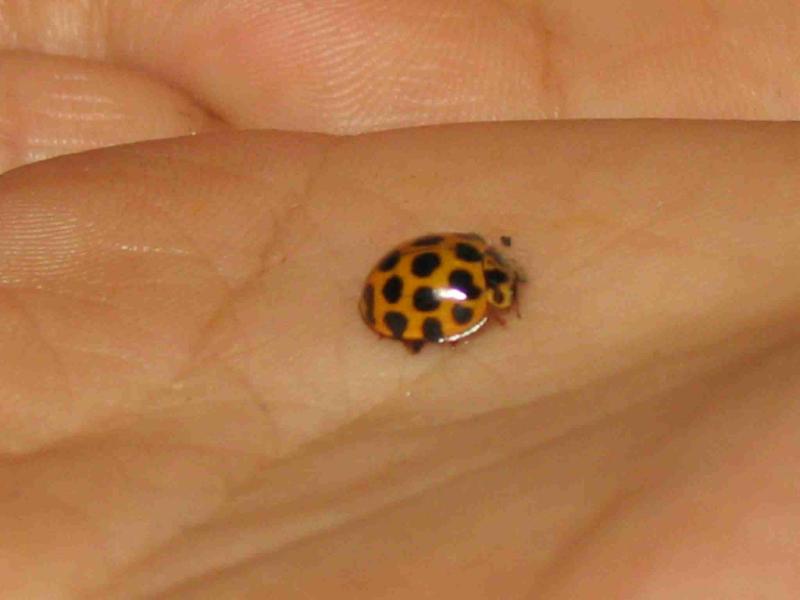
I came home from work today to find a little ladybird snuggled on my doona cover. Well with only 5 months under our belt it can't have been visiting as a 'sign' to us - unless it is one of those really long-range forecasting ladybirds!
Anyway my daughter wanted to hold it for luck and be photographed with it, before we released it on our rose bushes where it can live happily munching on the aphids.
Subscribe to:
Posts (Atom)